Midjourney v6 vs DALL-E 3 vs Stable Diffusion: Which AI Image Generator Wins in 2026?
Midjourney v6, DALL-E 3, and Stable Diffusion compared on quality, pricing, and control. Find out which AI image generator fits your workflow.
The AI image generation space has matured dramatically. What started as novelty outputs with distorted hands and nonsensical text has evolved into a set of genuinely professional-grade tools that designers, marketers, and developers are weaving into daily workflows. Three platforms dominate the conversation: Midjourney v6, DALL-E 3, and Stable Diffusion. Each takes a fundamentally different philosophy to image generation, and that philosophy shapes everything from output quality to cost to how much control you actually have.
This review breaks down each tool honestly — what it does well, where it falls short, and who it’s actually built for.
A Quick Orientation: What Each Tool Is
Before diving into head-to-head comparisons, it helps to understand the architectural and product differences at play.
Midjourney v6 is a proprietary model accessible primarily through Discord (with a web interface now in wider rollout). It’s designed for aesthetic output — cinematic, painterly, and highly polished images with minimal prompting effort. You cannot run it locally or access its weights.
DALL-E 3 is OpenAI’s third-generation image model, integrated directly into ChatGPT (Plus and Team tiers) and available via the OpenAI API. Its standout feature is conversational prompt refinement — you can iterate through natural language, making it approachable for non-designers.
Stable Diffusion (specifically the XL and SD 3.x lineages from Stability AI) is open-source and self-hostable. It requires more technical setup but gives you near-total control over fine-tuning, LoRA models, ControlNet pipelines, and commercial licensing of your outputs.
Image Quality: Where Does Each Tool Actually Excel?
Image quality is context-dependent, but there are consistent patterns across thousands of community evaluations and independent tests.
Midjourney v6 produces the most immediately impressive results for artistic and cinematic work. Lighting coherence, texture rendering, and compositional instinct are noticeably ahead of competitors in categories like portrait photography, architectural visualization, and fantasy illustration. The v6 update specifically improved text rendering within images — a long-standing weakness — and added stronger prompt adherence compared to v5.2.
DALL-E 3 has closed the gap significantly on photorealism and excels at concept illustration and diagrams. Its text rendering is arguably the strongest of the three for typographic elements embedded in scenes. Where it lags is in stylistic consistency and “aesthetic ceiling” — outputs tend to read as competent rather than stunning. The model also applies visible safety filtering that can clip creative requests, particularly around stylized violence, nudity, or ambiguous political content.
Stable Diffusion XL and SD 3.x are wildcards. Out of the box, base SDXL results are good but not competitive with Midjourney’s aesthetic polish. The power comes from the ecosystem: community fine-tunes on Civitai, ControlNet for pose and depth control, and LoRA layers that let you inject consistent characters or brand styles. If you invest the time, Stable Diffusion can match or exceed either competitor in specific niches — product photography, anime illustration, architectural rendering — but the baseline experience requires configuration.
Prompt Control and Usability
This is where the three tools diverge most sharply.
Midjourney uses a parameter-based prompting system (--ar, --style, --chaos, --weird) that rewards learning its syntax but feels opaque to newcomers. The v6 model significantly improved natural language understanding, so verbose descriptive prompts work better than they did in earlier versions. However, you’re still operating within a closed system — you can’t inspect model weights, adjust inference steps, or use negative prompting with the same granularity as open-source alternatives.
DALL-E 3’s integration into ChatGPT is its biggest usability advantage. You can describe a concept conversationally, ask for revisions (“make it more moody, add fog, keep the character the same”), and iterate without rewriting prompts from scratch. This feedback loop is genuinely faster for professionals who think in concepts rather than model parameters. The API allows programmatic generation at scale, which is useful for content pipelines.
Stable Diffusion, through interfaces like AUTOMATIC1111 or ComfyUI, exposes every lever: sampling method, CFG scale, seed control, inpainting masks, ControlNet conditioning signals. This is both the appeal and the barrier. A developer building a custom image pipeline will find no better tool. A marketer who needs a quick social graphic will find it overwhelming.
Pricing: What Does Each Tool Actually Cost?
Pricing is one of the most practically important factors and changes frequently — always verify current plans on official sites.
Midjourney operates on a subscription model:
- Basic: $10/month (~200 image generations)
- Standard: $30/month (15 GPU hours/month, unlimited relaxed generations)
- Pro: $60/month (30 GPU hours, stealth mode)
- Mega: $120/month (60 GPU hours)
There is no free tier as of 2024. The elimination of the free trial was a significant shift that drew criticism from hobbyists.
DALL-E 3 is included in ChatGPT Plus ($20/month), which also gives access to GPT-4o and other tools — making it strong value if you’re already in the OpenAI ecosystem. API pricing is usage-based: standard quality images at 1024×1024 are priced per image (check the OpenAI pricing page for current rates, as these have shifted). For high-volume generation, API costs can accumulate quickly.
Stable Diffusion is free to run locally if you have the hardware (a GPU with at least 6–8GB VRAM is recommended for SDXL). Cloud-based options like Stability AI’s own API or third-party services (RunDiffusion, Replicate) charge per compute second or per image. For studios running thousands of generations monthly, local deployment becomes significantly cheaper than subscription tools.
Comparison Table
| Feature | Midjourney v6 | DALL-E 3 | Stable Diffusion XL |
|---|---|---|---|
| Output Quality (Artistic) | ⭐⭐⭐⭐⭐ | ⭐⭐⭐⭐ | ⭐⭐⭐⭐ (with tuning) |
| Output Quality (Photorealism) | ⭐⭐⭐⭐⭐ | ⭐⭐⭐⭐ | ⭐⭐⭐⭐ |
| Text Rendering in Images | ⭐⭐⭐⭐ | ⭐⭐⭐⭐⭐ | ⭐⭐⭐ |
| Ease of Use | ⭐⭐⭐ | ⭐⭐⭐⭐⭐ | ⭐⭐ |
| Customization / Control | ⭐⭐⭐ | ⭐⭐⭐ | ⭐⭐⭐⭐⭐ |
| API Access | Limited | Full | Full (open weights) |
| Local / Offline Use | No | No | Yes |
| Commercial Licensing | Pro+ plans | OpenAI ToS | Open (check license) |
| Starting Price | $10/month | $20/month (ChatGPT Plus) | Free (self-hosted) |
| Content Moderation | Moderate | Strict | Minimal (self-hosted) |
Commercial Use and Licensing Considerations
This is a frequently misunderstood area. All three platforms allow commercial use under specific conditions, but the terms differ substantially.
Midjourney grants commercial rights to paid subscribers. Free tier users (when it existed) had non-commercial restrictions. The Pro plan adds “stealth mode” to keep your prompts and outputs private — relevant for agencies working on unreleased brand campaigns.
OpenAI’s usage policies permit commercial use of DALL-E 3 outputs, but prohibit generating images for specific categories (political misinformation, CSAM, etc.). The policies are detailed in OpenAI’s usage policies.
Stable Diffusion’s base models use the CreativeML Open RAIL-M license, which permits commercial use with restrictions on harmful applications. Many community fine-tunes carry their own licenses — critical to check before using in commercial products.
Who Should Use Which Tool?
Choose Midjourney v6 if: You’re a designer, creative director, or agency that prioritizes output quality and aesthetic consistency, iterates primarily through Discord or the web UI, and can absorb the subscription cost without needing full API flexibility.
Choose DALL-E 3 if: You’re already using ChatGPT Plus, want the fastest iteration loop through conversational refinement, need reliable text-in-image rendering, or are building a product on OpenAI’s API stack.
Choose Stable Diffusion if: You need full control over the generation pipeline, have technical resources to manage infrastructure, want to fine-tune on proprietary datasets, run high-volume generation where per-image costs matter, or require local/offline operation for data privacy reasons.
What the Numbers Say: Independent Testing in 2026
The strongest differentiator in 2026 is text rendering inside images — a metric that has gone from a known weakness across all AI image tools to a genuine point of divergence.
DALL-E 3 / GPT Image 1.5 now achieves approximately 95% accuracy on text-in-image rendering, making it the clear leader when legible typography is part of the visual — logos, infographics, product mockups with labels, per The Software Scout’s 2026 review. Midjourney v6 still struggles with text inside images: letters frequently distort, merge, or hallucinate entirely, especially on anything beyond three or four words, per AI Viewer’s comparative testing. Stable Diffusion occupies the middle ground — base models handle text poorly, but community plugins (Textual Inversion, ControlNet with text conditioning) let advanced users produce legible results that neither commercial tool can match for fine-grained control, per Lumichats’ comparison.
For artistic style preference, Midjourney holds a strong lead: human rater preference studies consistently show Midjourney outputs ranked first for “aesthetic appeal” and “professional polish” in photography and art categories. Stable Diffusion’s edge is architectural — it is the only tool that lets you run inference locally, fine-tune on proprietary datasets, or build a commercial product without per-generation API costs. For studios generating thousands of images per month, that ownership advantage compounds into real savings.
Conclusion
There is no single winner — but there are clear right answers for different use cases.
Midjourney v6 wins on raw aesthetic output. For creative professionals producing editorial imagery, concept art, or high-end marketing visuals, it consistently delivers results that require less post-processing than competitors. The lack of local deployment and API flexibility is a real constraint, but for the target audience, it’s an acceptable trade-off.
DALL-E 3 wins on accessibility and ecosystem integration. The conversational refinement workflow inside ChatGPT lowers the skill floor dramatically, and if you’re already paying for Plus, it’s effectively free. Its API is clean and well-documented for developers building image features into products.
Stable Diffusion wins on control, cost at scale, and customization depth. It demands more from users, but it’s the only tool that gives you genuine ownership — of the weights, the outputs, and the pipeline. For studios, developers, and researchers, that autonomy is worth the setup cost.
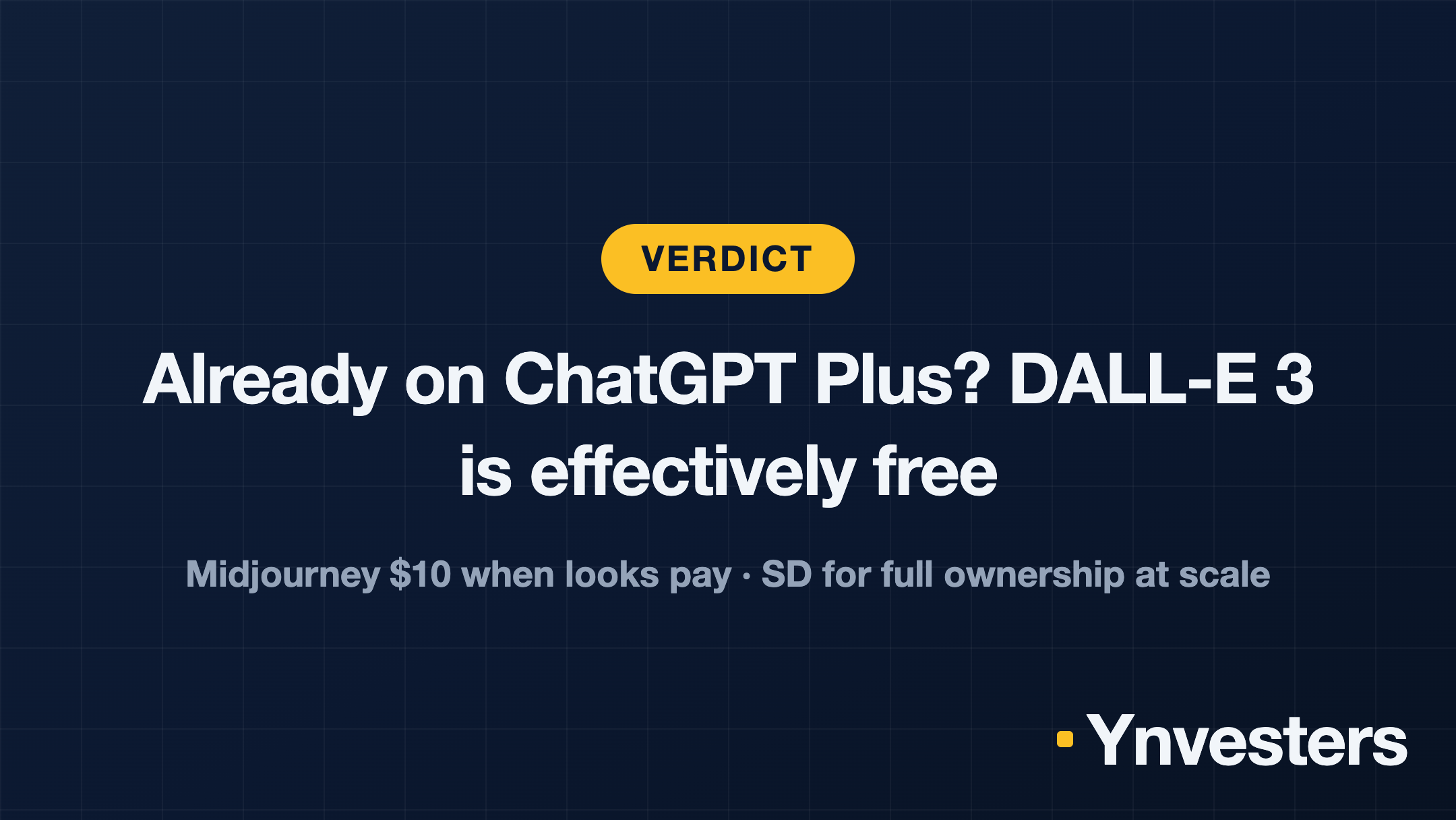
Our take, if you’re a solo creator paying out of pocket: check what you already pay for first. If you’re on ChatGPT Plus, DALL-E 3 is effectively free — and with ~95% text-in-image accuracy, it covers most practical creator work (thumbnails, mockups, labeled graphics) without a second subscription. Add Midjourney’s $10/month only when clients or audiences visibly reward the aesthetic difference — that’s its genuine lead, and it’s worth paying for the moment looks convert to income. Choose Stable Diffusion only if you’re technical and generating at real volume: ownership of weights and zero per-image costs compound, but the setup tax is real.
Frequently Asked Questions
Is Midjourney v6 worth it for a solo creator?
Only if aesthetic polish is a priority that DALL-E 3 cannot meet. The article recommends checking what you already pay for first — if you are on ChatGPT Plus, DALL-E 3 is effectively free, and adding Midjourney's $10/month Basic plan is only justified when clients or audiences demand a higher visual ceiling.
Midjourney v6 vs DALL-E 3: which is better for text inside images?
DALL-E 3 is the clear winner, achieving approximately 95% accuracy on text-in-image rendering. Midjourney v6 still frequently distorts, merges, or hallucinates letters, especially beyond three or four words.
How much does Stable Diffusion cost?
Stable Diffusion is free to run locally if you have a GPU with at least 6–8GB VRAM. Cloud-based options charge per compute second or per image, and for studios generating thousands of images monthly the article notes that local deployment becomes significantly cheaper than subscription tools.
Is DALL-E 3 worth it if I already pay for ChatGPT Plus?
Yes, according to the article. ChatGPT Plus costs $20/month and includes DALL-E 3 alongside GPT-4o, making it strong value if you are already in the OpenAI ecosystem — the article describes it as 'effectively free' for existing Plus subscribers.